SPECIAL OFFER!
Time left until the end:


Choose a service
KET tests
KET course
Exam accelerator
First aid course
Regitra routes map
How to Quickly Learn Driving Theory Test Questions: Step by Step
Many prospective drivers want to learn driving theory test questions as quickly as possible, but often choose the slowest path by trying to memorize the answers by heart. At first glance, this may seem like a simple and effective strategy, but as soon as the question wording or traffic situation changes, such knowledge quickly proves to be unreliable.
This is especially important considering that in 2025, only 38.3% of candidates passed the Category B theory exam on their first attempt. Failure is most often due not to complex rules, but to ineffective preparation, where too little attention is paid to understanding the logic of traffic regulations and too much time is spent on mechanical memorization of answers.
In this article, we will discuss how to quickly learn driving theory test questions, which learning methods yield the best results, how to analyze and repeat your mistakes, and how much time is realistically needed to prepare for the theory exam. You will also learn why some candidates do not pass the exam on the first try and how to avoid these mistakes when preparing for the "Regitra" theory exam.

Ekis Paprastai
2026 September 8
6 min. read

How to Quickly and Easily Learn Driving Theory Tickets: The Most Effective Methods
The fastest way is to continuously take tests and understand the logic of traffic rules, rather than mechanically memorizing answers. This is confirmed by the so-called testing effect: according to a meta-analysis published in the journal Psychological Bulletin (Rowland, 2014), self-testing by answering questions strengthens memory more than repeated reading of rules.
Understanding is more important than memorization for a very practical reason. The questions in the "Regitra" theory exam are often reformulated, so a candidate who has memorized answers often makes mistakes when faced with a differently worded question.
By understanding the essence of the rule, a candidate can correctly answer questions formulated in various ways.
Therefore, solving driving theory tests is one of the fastest ways to prepare for the exam. It simulates the real exam format and immediately shows which topics still have knowledge gaps. EKET simulation tests are based on the actual "Regitra" methodology, allowing you to realistically assess your level of preparation before the exam day.
The second essential principle is distributed learning over time. Instead of trying to learn all the material in one night, it's better to study a little bit over several consecutive days. A meta-analysis published in the journal Behavioral Sciences (2025) shows that spaced repetition helps to absorb information better than intensive learning right before the exam.
Practically, this means that regularity is more important than a single long study session. Even 20–30 minutes daily helps achieve stronger results.
The first logical step for beginners is to try the free driving theory test to immediately see your current knowledge level and weak points.
How to Solve Driving Theory Tickets and Review Only Mistakes?
The most effective way to solve driving theory tickets is to note only incorrect answers and later return specifically to them. Repeating what you already know well is not effective, so focusing on knowledge gaps allows you to achieve better results faster.
For each incorrect answer, read the related traffic rule section and its explanation. This helps to understand the essence of the rule, not just memorize one correct answer option. Complex sections are easier to remember using diagrams and clear explanations, as visual context helps to better understand the information.
For the most difficult topics, the flashcard method is especially useful. Save problematic questions separately and regularly review them until the answers become automatic. Such repetition helps to turn unstable knowledge into firm and long-lasting understanding.
Preparation is further accelerated by an individual learning program that creates a plan based on your weakest areas. Instead of repeating the entire course again, focus is placed on specific knowledge gaps, saving time and learning more purposefully.
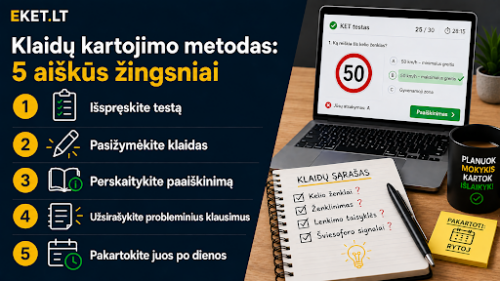
The mistake repetition method can be divided into several clear steps:
Complete the test without reviewing answers during the process.
Note the mistakes you made while taking the test.
Read the explanation for each incorrect answer to understand the logic of traffic rules.
Write down problematic questions in a separate list or on flashcards.
Review them the next day to check if the knowledge has solidified.
This cycle works best when repetition is spread over several days. Memory studies show that returning to mistakes with breaks helps to remember information better than a single review right before the exam.
Quick Learning Plan: How Much Time and in What Order to Study?
By studying intensively for 30–60 minutes daily, driving theory can be absorbed in 1–2 weeks. However, the decisive factor is regularity, not the total number of hours spent learning, as distributing repetition over several days helps to remember information better than trying to learn everything in one night.
Dedicate the first days to the main topics and road signs to get a general view of traffic rules. In the middle of the learning period, focus on error analysis and repetition, returning to noted incorrect answers. Dedicate the last days to full simulation tests with a time limit, as they help recreate real exam conditions.
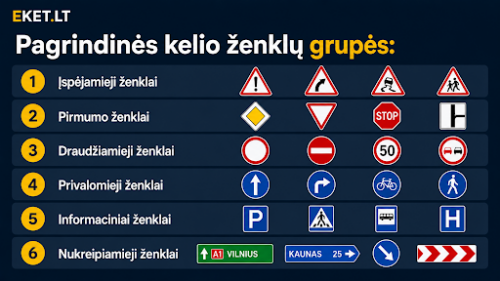
Learn road signs in groups according to their purpose, as related signs are easier and more logically remembered together than separately. Such a learning structure reduces confusion in the exam, where questions often present signs with similar purposes.
Main groups of road signs:
Warning signs, alerting about road hazards.
Priority signs, determining the right of way for road users.
Prohibitory signs, restricting or prohibiting certain actions.
Mandatory signs, indicating the direction of travel or traffic order.
Informational signs, providing important information to the driver.
Directional signs, helping to navigate the route.
Systematically learning road signs is aided by structured traffic rules material, where topics are presented in a sequential and logical order.
Before the exam, take control tests several times in a row. Consistently high results are one of the most reliable indicators that you are properly prepared, not just memorizing individual answers. If results fluctuate, it indicates that there are still knowledge gaps worth filling before registering for the "Regitra" theory exam.
Why People Fail the Theory Exam and Common Mistakes
According to official "Regitra" statistics, in 2025, only 38.3% of candidates passed the B category theory exam on the first attempt, while in 2015, this figure was 55.81%. This means that more than 6 out of 10 candidates do not pass the exam on the first try, and recent trends show a decreasing pass rate.
The main reason for failure is not a lack of knowledge, but superficial preparation. Many candidates memorize answers, so when they receive a paraphrased question, they make mistakes, even though they have solved a similar question before.
The second common problem is rushing. Candidates often register for the exam without achieving stable results, so even a small amount of stress on the exam day can lead to mistakes.
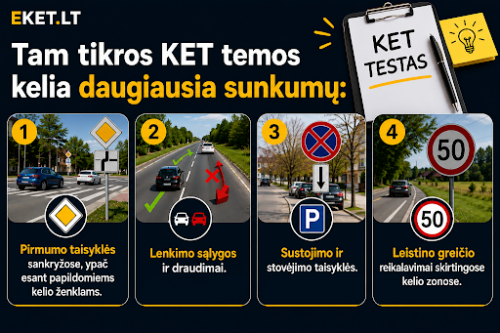
Certain driving theory topics pose the most difficulties because they require logical thinking, not just memorization of rules:
Right of way rules at intersections, especially with additional road signs.
Overtaking conditions and prohibitions.
Stopping and parking rules.
Speed limit requirements in different road zones.
These topics are closely related, so it's important to understand them as a cohesive system, rather than learning them as separate and unrelated points.
It's worth registering for the exam only when simulation test results are consistently high several times in a row. Such self-assessment of preparation helps reduce the risk of wasting time and incurring additional costs due to retaking the exam. When planning further preparation for the driving exam, it's useful to familiarize yourself with the most commonly used "Regitra" exam routes, which help to better understand the course of the practical exam.
Quality preparation, based on clear explanations, diagrams, and the opportunity to consult with a teacher, significantly increases the likelihood of passing the exam on the first try. This is because the candidate understands the essence of traffic rules, not just recognizes a previously seen question formulation.

Frequently asked questions
Here you will find answers to common questions. If you did not find your question, click Contact us and we will gladly help.

Did not find an answer?
Contact us and we will help!
Information updated 2026-09-08
Related articles

2026 September 8
6 min. read
How to Quickly Pass the Driving Theory Exam at "Regitra" (on the First Try)

Ekis Paprastai
2026 September 8
6 min. read
Do KET tickets match the "Regitra" exam? What is worth knowing
Ekis Paprastai

2026 September 3
7 min. read
Categories A, A1, A2, AM
Ekis Paprastai

2026 September 3
4 min. read
Vehicle Categories and Their Classification (Descriptions)
Ekis Paprastai
Other articles
Car dashboard symbols and their meanings
Driving Lessons: Requirements, Where to Learn, Price, FAQ
Best KET tests (tickets) 2026
Braking distance/stopping distance
Driving exam 2026: school test, at Regitra, mistakes
KET Speed Table 2026 PDF (permitted driving speeds)
B, B1, BE Categories
Beginner Driver: License, Tips, Traffic Violations
Driving categories 2026: Descriptions, requirements, notes
Traffic fines: speeding, driving without inspection and other violations 2026
Driving with the M Plate: Requirements, Opportunities, Pros and Cons, FAQ
When do you need to retake your driving license? [2026 Information]
AM CATEGORY TESTS (AM, A, A1, A2 Category Driving Theory Tests)
C kategorija
Railway crossing
Regitra theory exam 2026: procedure, cost, requirements
Category D
Tractor driving license: categories, requirements, costs
Regitra questions – 20 questions before the practical exam 2026
(NON) Critical Errors at Regitra: Possible Error Types 2026
Regitra Exam Fees – Theory and Practical License Costs
What do the regulator signals mean?
Lost driver's license: recovery, retaking exams, required documents



EKET.LT - More than just KET tests
EKET.LT is an innovative learning system helping you prepare for the Regitra theory exam. You will find not only KET tickets and tests here, but also constantly updated content, learning statistics, recommendations and the option to consult with an experienced instructor. Learn more effectively, track your progress and get ready to pass on the first try.
Copying or reusing any material published on “EKET.LT” is prohibited. 2021 - 2026.