SPECIAL OFFER!
Time left until the end:


Choose a service
KET tests
KET course
Exam accelerator
First aid course
Regitra routes map
Driving with the M Plate: Requirements, Opportunities, Pros and Cons, FAQ
Driving with the M plate allows learners to practice with a family member after passing the theory exam. It’s a great way to gain experience, but both the student, the instructor, and the car must meet specific legal requirements.

Ekis Paprastai
2026 August 28
7 min. read
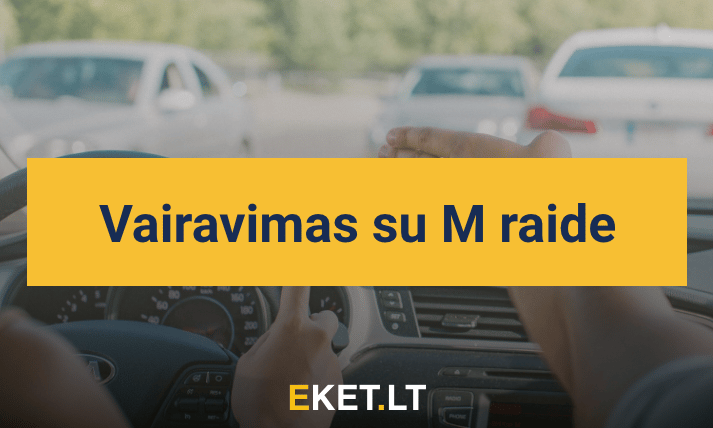
After passing the theory exam, many prospective drivers face the same question – is it worth starting to drive with a family member before completing training at a driving school? The opportunity to get behind the wheel of a car marked with the letter M allows for more practice, better understanding of real traffic situations, and gaining confidence, which is often lacking during the first driving lessons.
However, driving with a family member is not just additional practice. Specific requirements apply to the learner, the family instructor, and the car, and responsibility for following the rules lies not only with the learner but also with the teaching person. Moreover, although such learning has many advantages, it also has certain drawbacks that are worth knowing in advance.
In this article, we will discuss who can drive with the M mark, what documents and requirements apply during training, where it is allowed to learn to drive, and what advantages and challenges are most often identified by both learners and their family members.
Driving with the M Mark
The M mark on cars indicates that the car is being driven by a prospective driver together with a family member. Driving with a family member is useful for deepening driving skills, road orientation, and vehicle control abilities. To learn with a family member, one must know the requirements for the learner, the family member, and the car. Learning to drive with a family member does not exempt from the requirement to complete 30 academic hours with a professional driving instructor at school and to pass the school driving exam.
To obtain a temporary driver's license (M mark), candidates must successfully pass the theoretical exam. Eket.lt helps students prepare for the theoretical exam and obtain a temporary driver's license with the "M" mark. By solving KET tickets, students acquire the necessary knowledge about traffic rules, which they later apply in practical driving.
Requirements for the Learner and Family Driving Instructor
Who Can Learn to Drive with a Family Member?
Individuals who can learn to drive with a family member:
Have already passed the theory exam at "Regitra";
Are at least 17 years old.
Who Can Teach Driving?
Family driving instructor is a family member who teaches practical driving skills to another family member. Driving can be taught by:
Only family members (parents, spouses, children and adopted children, siblings, grandparents, and grandchildren). Children under guardianship or custody according to Lithuanian law are considered family members.
Family members with at least 5 years of experience driving B category vehicles.
Cannot teach if the family member has been deprived of the right to drive vehicles due to KET violations.
What Documents Are Required During Training?
The family driving instructor must have during training:
An identity document;
Documents proving that the family driving instructor and the learner are family members (e.g., marriage certificate, birth certificate, etc.)
A valid driver's license.
The learner must have:
An identity document;
A "Regitra" certificate of passing the theory exam;
A valid driver's health check medical certificate.
What Car Can Be Used for Driving Training?
Driving training can be conducted with a car:
B category car that is registered, has a valid technical inspection, and mandatory insurance (when teaching a family member, it is additionally recommended to check the insurance conditions);
A car whose front and rear are marked with clearly visible "M" signs, as required by KET. A luminous pyramid sign on the roof with the "M" letter, additional mirrors, and pedals, which are necessary for a driving school car, are not required, but additional mirrors for the family member will be useful and make the training safer.
Cannot use cars where the parking brake control lever is not installed between the driver's and passenger's seats.
Learning to drive with a family member can also be done with a car that does not belong to the same family member, for example, a friend's, aunt's, uncle's, or another person's car. It is important that the car is technically sound, meets the requirements, and has all the necessary documents (vehicle registration certificate, technical inspection results card, mandatory civil liability insurance certificate).
Where to Place the M Mark?
During training, the front and rear of the car must be marked with a white equilateral triangle-shaped sign with a red border and a black "M" letter in the middle. The side length of the triangle is 200–300 mm, and the border width is 1/10 of the side length. Such signs can be purchased in many stores.
Where Can You Learn to Drive with a Family Driving Instructor?
It is recommended to start learning in designated areas – prepared by driving schools or other less used areas. It is important to ensure that the learner understands how to turn the steering wheel, shift gears, and brake safely before going out into the streets and traffic. After mastering the essential skills, you can drive on busier streets.
KET defines that learning to drive is also allowed on highways and expressways. On highways, learner cars are allowed to drive at a maximum speed of 100 km/h, on expressways – a maximum of 90 km/h, on roads with asphalt or concrete surfaces – a maximum of 80 km/h, on other roads – a maximum of 70 km/h, in settlements – a maximum of 50 km/h, and in residential areas – a maximum of 20 km/h.
Choose a time of day for learning to drive when traffic is less intense. This way, you can learn more calmly and not disrupt other vehicles' traffic. If possible, try driving in various weather conditions, but avoid heavy rain or blizzards.
What Are the Disadvantages of Learning to Drive with a Family Member?
Driving with a family member will undoubtedly help you gain confidence on the road, but such learning has a few disadvantages:
The family member assumes significant responsibility. The family driving instructor must ensure that the learner does not create hazardous situations and drives safely. The family instructor must also take care of all necessary documents (both personal and vehicle), otherwise, there is a risk of receiving a fine.
The family member is unlikely to teach driving according to precise "Regitra" requirements. After driving for several years, the knowledge from the practical exam tends to "wear off," and driving not entirely according to the rules begins, so these non-compliant driving skills may be passed on to the learner by the family instructor.
The car at "Regitra" may be different. Even if you become proficient at driving with a family member's car, as a beginner driver, it may be difficult to adapt to the operation of the "Regitra" car. Meanwhile, many driving schools have identical or similar vehicles to those at "Regitra".
Lessons with a family member alone will not be enough. No matter how well you drive with a family instructor, you will still need to drive 30 academic hours with a driving school instructor.
What Is Important to Remember When Learning to Drive with a Family Member?
The family driving instructor (family member) is responsible for complying with KET and family member training requirements during training.
Learning to drive with a family member can be done at any time of day. During training, the family member teaching driving must be nearby and observe the driving.
The family driving instructor is responsible for complying with KET and family member training requirements during training.

Frequently asked questions
Here you will find answers to common questions. If you did not find your question, click Contact us and we will gladly help.

Did not find an answer?
Contact us and we will help!
Information updated 2026-08-28
Related articles
2026 September 1
5 min. read
Driving categories 2026: Descriptions, requirements, notes

Ekis Paprastai

2026 September 3
7 min. read
Categories A, A1, A2, AM
Ekis Paprastai
2026 March 7
6 min. read
Driving Lessons: Requirements, Where to Learn, Price, FAQ
Ekis Paprastai
-thumb.png)
2026 August 31
2 min. read
Regitra Exam Fees – Theory and Practical License Costs
Ekis Paprastai
Other articles
Regitra theory exam 2026: procedure, cost, requirements
Vehicle Categories and Their Classification (Descriptions)
Lost driver's license: recovery, retaking exams, required documents
Railway crossing
Driving exam 2026: school test, at Regitra, mistakes
AM CATEGORY TESTS (AM, A, A1, A2 Category Driving Theory Tests)
What do the regulator signals mean?
Traffic fines: speeding, driving without inspection and other violations 2026
Best KET tests (tickets) 2026
Braking distance/stopping distance
(NON) Critical Errors at Regitra: Possible Error Types 2026
When do you need to retake your driving license? [2026 Information]
B, B1, BE Categories
Beginner Driver: License, Tips, Traffic Violations



EKET.LT - More than just KET tests
EKET.LT is an innovative learning system helping you prepare for the Regitra theory exam. You will find not only KET tickets and tests here, but also constantly updated content, learning statistics, recommendations and the option to consult with an experienced instructor. Learn more effectively, track your progress and get ready to pass on the first try.
Copying or reusing any material published on “EKET.LT” is prohibited. 2021 - 2026.