SPECIAL OFFER!
Time left until the end:


Choose a service
KET tests
KET course
Exam accelerator
First aid course
Regitra routes map
KET Speed Table 2026 PDF (permitted driving speeds)
To download the latest driving speed chart CLICK HERE .

Ekis Paprastai
2026 August 31
6 min. read
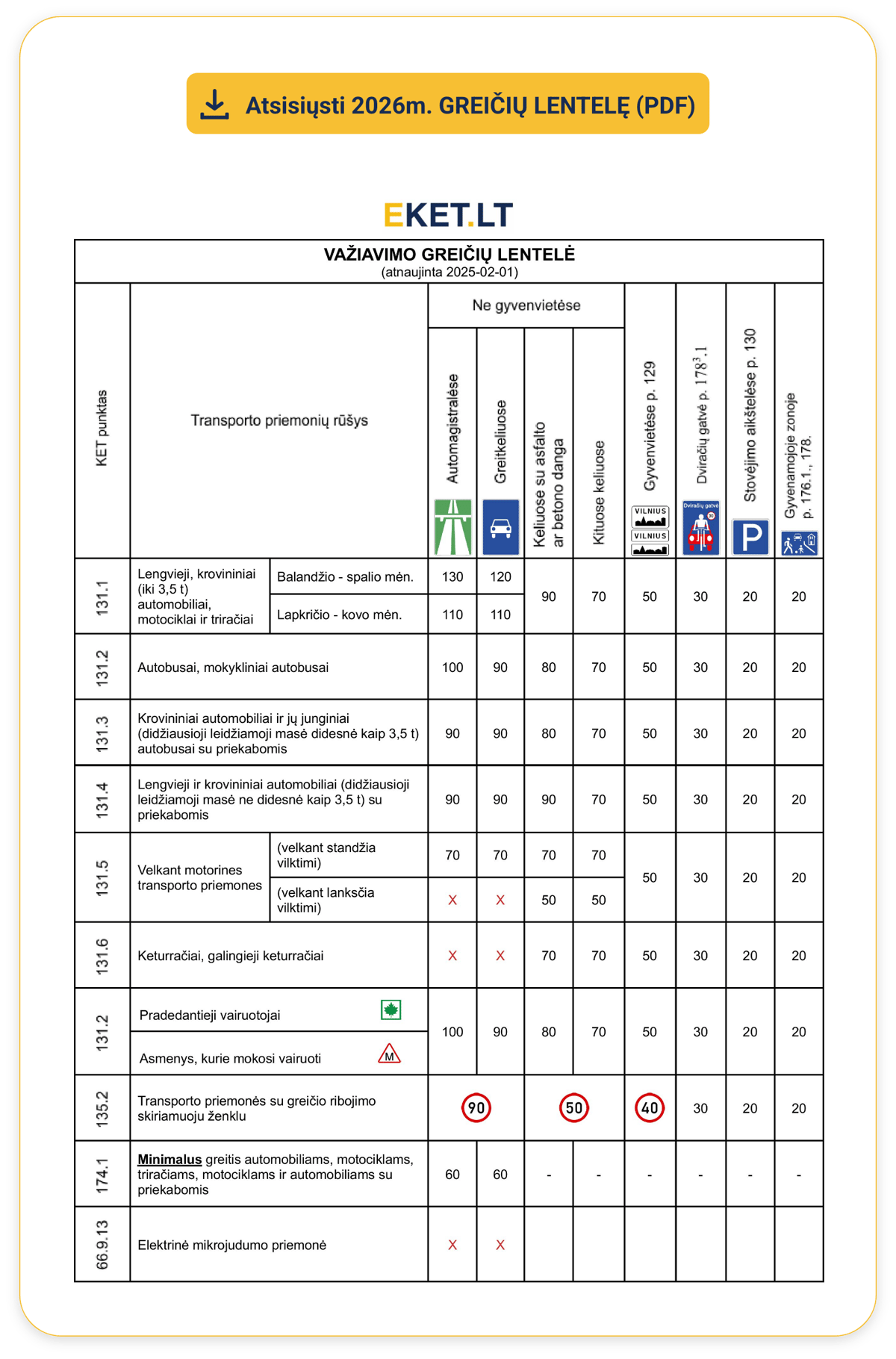
The permissible driving speed is one of the most important topics in Traffic Rules, yet it is also one of the most commonly confused. Many drivers know the basic speed limits, but do not always remember the requirements for novice drivers, vehicles with trailers, or driving on highways at different times of the year.
Due to questions about speed limits, mistakes often occur both in the driving theory exam and in everyday traffic participation. Even a small oversight can lead not only to a fine but also to a dangerous situation on the road. Therefore, it is important not only to know the permissible speed but also to understand when and why it changes depending on the circumstances.
In this article, you will find the relevant 2026 Traffic Rules speed limit table, the main permissible speeds for different vehicles, rules in residential areas and bicycle streets, and other important information that will help you better prepare for the theory exam and participate more safely in traffic.
Driving Speed (Traffic Rules 127-135 p.)
127. The driver must drive without exceeding the permissible speed. When choosing the driving speed, the driver must consider the driving conditions, especially the terrain, the condition of the road and the vehicle, the load, meteorological conditions, and traffic intensity, to be able to stop the vehicle before any foreseeable obstacle. He must slow down and, if necessary, stop if required by the circumstances, especially when visibility is poor.
128. If an obstacle arises or a threat to traffic safety occurs, the driver (if he can notice it) must slow down, even completely stop the vehicle or bypass the obstacle without endangering other road users.
129. In residential areas, all vehicles are allowed to drive at a speed not exceeding 50 km/h.
130. In parking lots, all vehicles are allowed to drive at a speed not exceeding 20 km/h.
131. Outside residential areas, it is allowed to drive:
131.1. with passenger cars, trucks with a maximum permissible mass not exceeding 3.5 t, motorcycles, and tricycles on highways from April to October at a speed not exceeding 130 km/h, from November to March at a speed not exceeding 110 km/h, on expressways from April to October at a speed not exceeding 120 km/h, from November to March at a speed not exceeding 110 km/h, on roads with asphalt or concrete surfaces at a speed not exceeding 90 km/h, on other roads at a speed not exceeding 70 km/h;
131.2. with A1, A2, A, or B category vehicles driven by novice drivers, learners, or those taking a practical driving exam, buses (including school buses) on highways at a speed not exceeding 100 km/h, on expressways at a speed not exceeding 90 km/h, on roads with asphalt or concrete surfaces at a speed not exceeding 80 km/h, on other roads at a speed not exceeding 70 km/h;
131.3. with trucks with a maximum permissible mass exceeding 3.5 t, as well as combinations of these trucks and trailers, buses with trailers on highways and expressways at a speed not exceeding 90 km/h, on roads with asphalt or concrete surfaces at a speed not exceeding 80 km/h, on other roads at a speed not exceeding 70 km/h;
131.4. with passenger cars and trucks with a maximum permissible mass not exceeding 3.5 t, with trailers on highways, expressways, and roads with asphalt or concrete surfaces at a speed not exceeding 90 km/h, on other roads at a speed not exceeding 70 km/h;
131.5. towing motor vehicles with a rigid tow at a speed not exceeding 70 km/h, and towing with a flexible tow at a speed not exceeding 50 km/h;
131.6. with quadricycles, powerful quadricycles at a speed not exceeding 70 km/h;
131.7. with tractors and self-propelled machines at a speed not exceeding 50 km/h.
132. If the permissible speed on roads is increased or decreased by appropriate road signs, the driver must comply with the road signs' requirements, but the driver's chosen driving speed in residential and non-residential areas cannot exceed the maximum permissible speed set in Rule 131 for the respective vehicle or its combination with a trailer.
133. On road sections where traffic conditions allow safe driving at higher speeds, the permissible speed may be increased by the road owner's decision by installing appropriate road signs.
135. The driver is prohibited from:
135.1. exceeding the maximum speed set by the vehicle manufacturer, regardless of whether a higher permissible speed is set by a road sign;
135.2. exceeding the speed indicated on the vehicle's speed limitation sign;
135.3. driving unnecessarily too slowly, hindering the normal flow of other vehicles;
135.4. braking sharply unless necessary for traffic safety.
Traffic in Residential Areas (Traffic Rules 175-178 p.)
175. Pedestrians are allowed to move on the roadway throughout the residential area, but they must not obstruct vehicle traffic. In residential areas, pedestrians have the right of way over vehicles.
176. In residential areas, it is prohibited to:
176.1. drive at a speed exceeding 20 km/h;
176.2. keep the vehicle engine running longer than necessary to prepare the vehicle for driving (clearing snow, etc.);
176.3. leave parked trucks with a maximum permissible mass exceeding 3.5 t, buses with more than 12 seats, as well as tractors, self-propelled machines, and their trailers;
176.4. overtake.
177. The driver of a vehicle entering a road from a residential area must yield to approaching vehicles and pedestrians whose path he crosses.
177.1p. In residential areas, the requirements set in Rules 57 and 66.3 for riding in a single file and as close as possible to the right edge of the traffic lane do not apply to cyclists and drivers of electric micro-mobility devices.
178. The requirements of this section also apply to the courtyards of multi-apartment residential buildings. The provisions of Rule 175 and subparagraph 176.4 apply to parking lots.
Traffic in Bicycle Streets (Traffic Rules 178 p.)
178.1p. A bicycle street is intended for mixed traffic of non-motorized and motorized vehicles.
178.2p. In a bicycle street, the requirements set in Rules 57 and 66.3 for riding in a single file and as close as possible to the right edge of the traffic lane do not apply to cyclists and drivers of electric micro-mobility devices.
178.3p. In a bicycle street, it is prohibited to:
178.3p.1. drive at a speed exceeding 30 km/h;
178.3p.2. overtake.
To better prepare for the theory exam and familiarize yourself with all driving speed rules, it is useful to practice with Traffic Rules tests. Free Traffic Rules tests will help reinforce knowledge about permissible speeds and other traffic rules, making it easier to pass the exam at "Regitra". This will provide confidence and ensure that you are ready to comply with all road requirements.
Try KET tests!
Prepare for the Regitra theory exam with EKET Tickets

9/10 EKET students pass on the first try!

Frequently asked questions
Here you will find answers to common questions. If you did not find your question, click Contact us and we will gladly help.

Did not find an answer?
Contact us and we will help!
Information updated 2026-08-31
Related articles

2026 September 3
7 min. read
Categories A, A1, A2, AM

Ekis Paprastai
2026 September 3
4 min. read
Vehicle Categories and Their Classification (Descriptions)
Ekis Paprastai

2026 August 27
1 min. read
Car dashboard symbols and their meanings
Ekis Paprastai

2026 March 7
2 min. read
Braking distance/stopping distance
Ekis Paprastai
Other articles
Driving categories 2026: Descriptions, requirements, notes
Traffic fines: speeding, driving without inspection and other violations 2026
Driving with the M Plate: Requirements, Opportunities, Pros and Cons, FAQ
Regitra questions – 20 questions before the practical exam 2026
AM CATEGORY TESTS (AM, A, A1, A2 Category Driving Theory Tests)
C kategorija
Driving Lessons: Requirements, Where to Learn, Price, FAQ
Best KET tests (tickets) 2026
Lost driver's license: recovery, retaking exams, required documents
(NON) Critical Errors at Regitra: Possible Error Types 2026
When do you need to retake your driving license? [2026 Information]
B, B1, BE Categories
Beginner Driver: License, Tips, Traffic Violations



EKET.LT - More than just KET tests
EKET.LT is an innovative learning system helping you prepare for the Regitra theory exam. You will find not only KET tickets and tests here, but also constantly updated content, learning statistics, recommendations and the option to consult with an experienced instructor. Learn more effectively, track your progress and get ready to pass on the first try.
Copying or reusing any material published on “EKET.LT” is prohibited. 2021 - 2026.