SPECIAL OFFER!
Time left until the end:


Choose a service
KET tests
KET course
Exam accelerator
First aid course
Regitra routes map
How to Quickly Pass the Driving Theory Exam at "Regitra" (on the First Try)
Passing the driving theory exam on the first attempt is not as simple as it may seem. Although many believe that a few days of solving test questions or reading the Traffic Rules is sufficient, statistics suggest otherwise. In 2025, only 38.3% of candidates passed the Category B theory exam on their first try. This means that many prospective drivers face additional waiting, retake fees, and delayed receipt of their driver's license.
However, the problem often lies not in a lack of knowledge. Many candidates study inefficiently: they try to memorize answers by heart, do not analyze their mistakes, or pay too little attention to the most complex topics. Meanwhile, candidates who understand the logic of the Traffic Rules and regularly test their knowledge with exams structured like the real one tend to achieve better results in a shorter time.
In this article, we will discuss how to quickly prepare for the driving theory exam at "Regitra," what mistakes most often hinder candidates, and which learning methods help maximize the chances of passing the exam on the first attempt. You will also learn how many mistakes can be made in the exam, what its structure is, and how to objectively assess whether you are ready to register for the exam.

Ekis Paprastai
2026 September 8
6 min. read

How to Quickly Pass the Driving Theory Exam at "Regitra" on the First Try: An Effective Plan
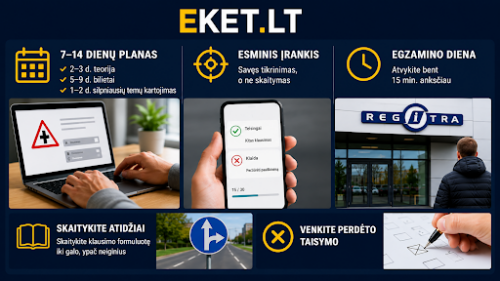
The fastest path to success is concentrated learning spread over several days, combining theory review with intensive test solving. Scientific studies show that reviewing learning material over several days is more effective than trying to learn everything in one night before the exam. Therefore, even quick preparation should be divided into several stages.
A realistic plan fits into 7–14 days. Dedicate the first 2–3 days to reviewing the theory course to establish the basics of the Traffic Rules. The middle stage should be devoted to solving tickets and analyzing mistakes, and the last 1–2 days to calmly revisiting the weakest topics.
The most important tool for quick preparation is self-testing, not repeated reading. Answering test questions strengthens memory more due to the so-called testing effect, as the effort to recall the answer helps to embed the information deeper than simple text reading. Therefore, solving tickets should make up the majority of your preparation time.
On the exam day, arrive at the "Regitra" branch at least 15 minutes early to have time to calm down. Read each question's wording carefully and completely, especially if a negation is used in the sentence. Avoid over-correcting answers, as the first intuitive choice, based on preparation, is usually correct.
Such methodical preparation helps save time and money. If the exam is not passed, it can be retaken no earlier than 7 calendar days later, so one failure delays obtaining a driver's license by at least a week.
However, quality preparation should not be chaotic. A clear plan, tests with explanations, and consistent error correction are what distinguish candidates who pass on the first try from those who have to retake the exam.
The Hardest Part of the Exam and Common Mistakes
The hardest questions are those requiring logical thinking and negation forms that do not have a straightforward "yes" or "no" answer. These help distinguish true understanding of the Traffic Rules from superficial memorization.
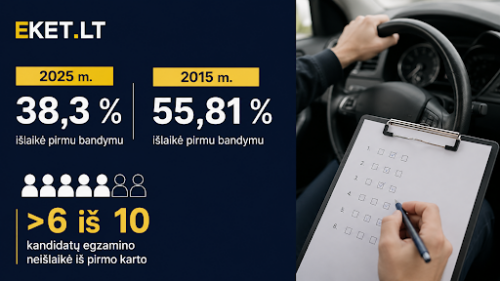
The complexity of the exam is confirmed by "Regitra" statistics. In 2025, only 38.3% of candidates passed the B category theory exam on the first attempt, while in 2015, this figure was 55.81%. This means more than 6 out of 10 candidates did not pass the exam on the first try, making preparation quality a decisive factor.
Most mistakes are caused by questions with multiple correct answers. For example, situations at intersections where you need to not only recognize a road sign but also simultaneously assess priority rules and the actions of other road users. Such questions require contextual understanding rather than mechanical answer selection.
The most common reason for failure is rote memorization of test answers instead of understanding the logic of the Traffic Rules. Since exam questions are presented in random order and often rephrased, memorized answer sequences become worthless.
What happens when you encounter a question you've never seen before? Someone who understands the rules' logic can easily solve it because they rely on principles rather than memorized templates. Meanwhile, rote memorization collapses as soon as the wording changes.
Therefore, the most effective preparation is based on understanding the essence of the Traffic Rules, which is formed by clear explanations and practical examples. This method allows answering variously formulated questions and significantly increases the likelihood of passing the exam on the first try.
How to Prepare Effectively: Driving Theory Course and Tests with Explanations
The most effective preparation combines a structured theory course with intensive test solving, as the former provides a solid knowledge base, and the latter helps to consolidate and apply it practically. The theory course can be taken at a driving school or online.
The online format allows learning at your own pace and saves time, as there is no need to adhere to a group schedule. Therefore, it is especially suitable for preparing for the exam in a short time.
The test-solving methodology determines how quickly you will absorb the material. After each question, read the explanation, analyze why the answer is correct, and return to the weakest topics. Explanations turn a mistake into a learning opportunity, so making mistakes while solving tests is beneficial, not scary.
A clear preparation indicator helps objectively assess your knowledge. Before registering for the exam, consistently aim for 90–100% correct answers in the tests you solve. A single good result is not enough, as consistency is key.
Simulated tests, compiled according to the actual "Regitra" methodology, help assess the real level of preparation, as their question format, complexity, and structure match the exam. This way, surprises are avoided on the exam day. You can check your knowledge by taking a free driving theory test.
Preparation is further accelerated by an individual learning program tailored to the weakest areas, as time is allocated to the topics that need it most. On the EKET platform, the system automatically creates such a plan, and if questions arise, answers can be obtained directly from the teacher.
Teacher assistance is especially useful when solving logical and negation form questions, which often raise doubts. Such an individual approach increases the likelihood of passing the exam on the first try and shortens the overall preparation time.
What is the Driving Theory Exam: Number of Questions, Categories, and the 80% Threshold
The driving theory exam is a set of questions solved on a computer at a "Regitra" branch, testing knowledge of the Traffic Rules. Each question has one or more correct answers, so careful reading of the question's wording often determines the result more than the speed of answering.
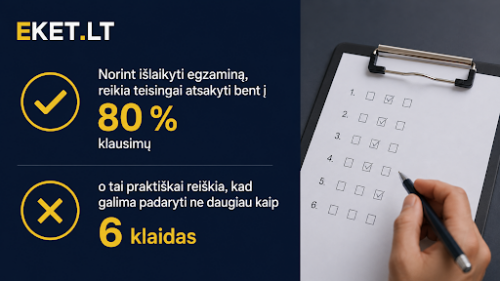
To pass the exam, you need to correctly answer at least 80% of the questions, which practically means you can make no more than 6 mistakes. Exceeding this threshold results in a failed exam, requiring registration for a retake.
The theory exam is taken by future AM, A, and B category drivers who meet the age requirements and have completed a driving training course. Without this preparation, a person cannot be registered for the exam, as the driving school confirms that the student has acquired the necessary theoretical foundation. It is also worth taking care of other required documents, such as completing first aid courses in advance, which are necessary to obtain a driver's license.
A passed theory exam is valid for a limited time, during which the practical exam must also be passed. Therefore, it is worth planning the practical exam soon after the theory exam, as once its validity period expires, the theory would have to be retaken.
When preparing for the driving exam, it is also useful to familiarize yourself in advance with the most commonly used "Regitra" exam routes to better understand the situations in which future drivers' skills are most often evaluated.
Solid preparation starts with understanding the rules themselves, not memorizing answers. Those wishing to deepen their knowledge would benefit from reviewing the structured Traffic Rules material, where complex provisions are explained with simple examples.
A clear understanding of the exam structure reduces stress, as it allows you to know exactly what to expect on the exam day.

Frequently asked questions
Here you will find answers to common questions. If you did not find your question, click Contact us and we will gladly help.

Did not find an answer?
Contact us and we will help!
Information updated 2026-09-08
Related articles

2026 September 8
6 min. read
Do KET tickets match the "Regitra" exam? What is worth knowing

Ekis Paprastai

2026 September 8
6 min. read
How to Quickly Learn Driving Theory Test Questions: Step by Step
Ekis Paprastai

2026 September 3
7 min. read
Categories A, A1, A2, AM
Ekis Paprastai

2026 September 1
8 min. read
Regitra theory exam 2026: procedure, cost, requirements
Ekis Paprastai
Other articles
Car dashboard symbols and their meanings
Traffic fines: speeding, driving without inspection and other violations 2026
Best KET tests (tickets) 2026
Braking distance/stopping distance
Driving exam 2026: school test, at Regitra, mistakes
KET Speed Table 2026 PDF (permitted driving speeds)
B, B1, BE Categories
Beginner Driver: License, Tips, Traffic Violations
Driving Lessons: Requirements, Where to Learn, Price, FAQ
Vehicle Categories and Their Classification (Descriptions)
Tractor driving license: categories, requirements, costs
Regitra questions – 20 questions before the practical exam 2026
(NON) Critical Errors at Regitra: Possible Error Types 2026
Regitra Exam Fees – Theory and Practical License Costs
What do the regulator signals mean?
Lost driver's license: recovery, retaking exams, required documents



EKET.LT - More than just KET tests
EKET.LT is an innovative learning system helping you prepare for the Regitra theory exam. You will find not only KET tickets and tests here, but also constantly updated content, learning statistics, recommendations and the option to consult with an experienced instructor. Learn more effectively, track your progress and get ready to pass on the first try.
Copying or reusing any material published on “EKET.LT” is prohibited. 2021 - 2026.